Getting internal threads right is all about choosing the right thread tap[^1]. If the tap is mismatched to the material, hole shape, or machine, you risk defects, tap breakage, and lost productivity. What are the main types of thread taps, their advantages and limitations, and how do you select and apply them for modern industrial production?
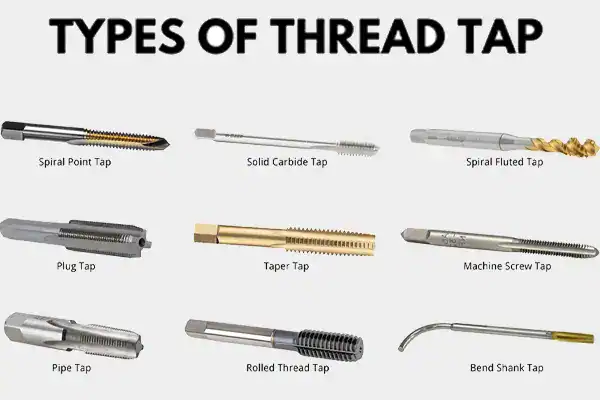
Thread taps are divided into straight flute, spiral flute, spiral point, and forming taps. Each type is optimized for specific materials, hole geometry, and production methods. Proper selection and process control are essential for precision, reliability, and efficiency when tapping internal threads.
The thread tap is a fundamental but highly demanding cutting tool Taps create threads “inside” a hole by either cutting or cold forming, and each variant has unique design requirements for geometry, material, and coatings. Selection mistakes quickly lead to breakage, poor thread fit, or even destructive interference with other manufacturing steps.
What is a Thread Tap?
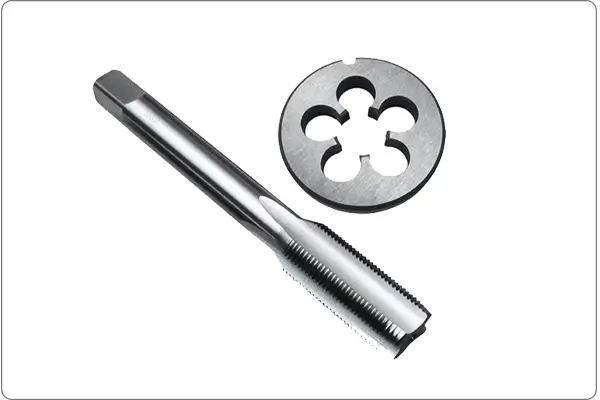
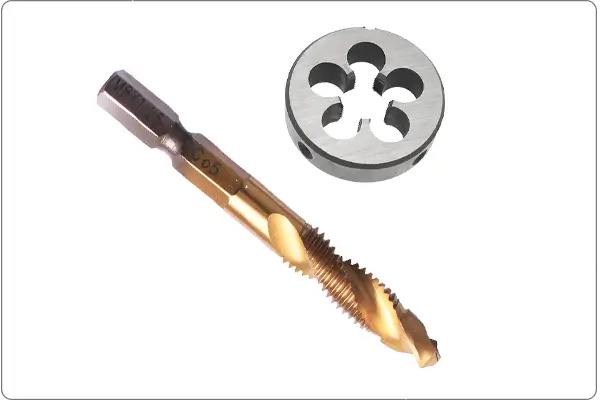
A thread tap is a multi-tooth cutting tool designed for generating internal threads. Taps come in multiple shapes and styles to match workpiece material, hole depth, and production demands.
Thread taps cut or form threads in pre-drilled holes. They may be applied manually or in CNC production for precise thread geometry, strong engagement, and clean chip evacuation. The correct tap features appropriate material, geometry, coatings, and tolerances for the job.

Taps are engineered to maximize durability, chip clearance, and surface finish. Since each tooth shares part of the cutting load and chip evacuation, tool life and threading quality depend on selecting the optimal tap for your part and operation.
What Are the Different Types of Thread Taps?
Modern thread taps vary by their groove shape, thread profile, lead geometry, and even chip management strategies. Here are the four principal types:
1. Straight Flute Taps
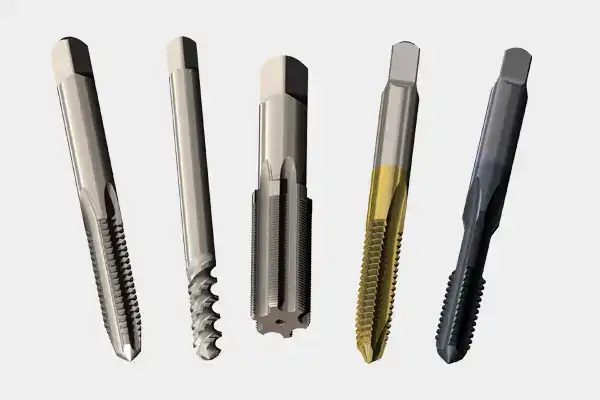
Straight flute taps have linear grooves for chip removal and are the most basic, versatile option. They are typically used for through-holes or in cast iron, and are available in hand taps and machine-style versions.
Straight flute taps are durable and cost-effective, ideal for short chip materials like gray cast iron, brass, or general engineering steels. They offer best rigidity but limited chip control and are less effective for deep or blind holes in ductile metals.
Technical Focus
- Construction: Parallel flutes with 2–6 teeth; cone or chamfered lead available.
- Best Applications: Through holes, coarse/fine threads in steel or cast iron, general-purpose shop work.
- Advantages: Simple, robust and low-cost; strong cutting edge.
- Limits: Poor chip evacuation in blind holes; not recommended for high-toughness alloys or deep threads.
2. Spiral Flute Taps
Spiral flute taps present helical flute geometry, designed to lift chips out of deep or blind holes. The spiral angle can be adjusted—lower (15–30°) for harder steels, higher (35–45°) for soft aluminum or copper alloys.
Spiral flute taps excel in blind holes and ductile metals where chip packing is so severe that standard straight flutes jam or break. They form highly accurate threads with excellent surface finish if matched to the proper application.
Technical Focus
- Construction: Helical flutes, right-hand or left-hand, varied pitch and spiral angle.
- Best Applications: Blind holes (>2x diameter), ductile alloys (aluminum, stainless steel, copper).
- Advantages: Superior chip clearance, lower torque, minimized jamming.
- Limits: Lower size range (up to M36 recommended); less rigidity for high-torque conditions.
3. Spiral Point Taps (Gun Taps)
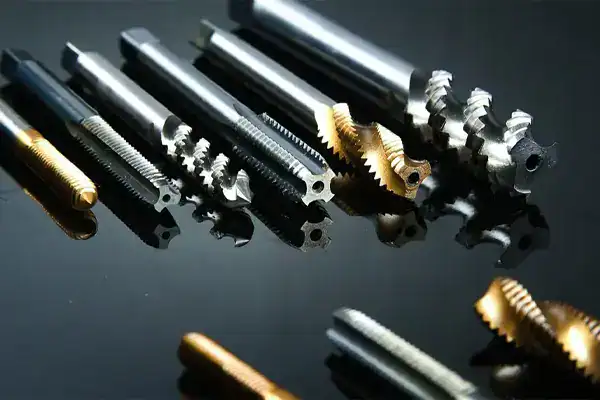
Spiral point taps are engineered to push chips forward, straight through the hole. The wedge-shaped “gun” tip improves chip curling and is designed for fast, efficient through-hole tapping.
Spiral point taps deliver maximum speed and chip removal for through holes in steels, non-ferrous metals, and certain plastics. They cannot be used in blind holes due to chip packing.
Technical Focus
- Construction: Straight flutes with modified, wedged point.
- Best Applications: Through hole tapping (steel, aluminum, brass), CNC lines, automatic machines.
- Advantages: Fast cycle time, no chip blockage, improved quality and surface finish.
- Limits: Not for blind holes or manual tapping where chips can’t escape.
4. Forming Taps (Roll Taps)
Forming taps uniquely generate threads by plastic deformation—not cutting. These taps “displace” material upwards and into the internal thread profile, producing a burr-free, very strong thread.
Forming taps are best for soft, ductile metals such as aluminum, copper, low carbon steel, often in small or thin parts, or where chip control problems dominate production. No chips are produced—eliminating jamming and broken tap risks.
Technical Focus
- Construction: No cutting flutes, polygonal/profiled lobes, short lead.
- Best Applications: Electronics, automotive, assembly, blind holes in soft, ductile alloys.
- Advantages: Superior surface finish, enhanced thread strength, zero chip generation.
- Limits: Not suitable for hard/brittle materials; internal threads may show fine grooves, so not always ideal for sealing/tightness.
Materials, Geometry and Coatings for Thread Taps
Material selection is crucial for tap durability and efficiency. The most frequently used are:
- HSS (High-Speed Steel)[^2]: General-purpose, affordable, moderate wear resistance. Best in low to medium hardness metals.
- Cobalt HSS[^3] (M35/M42): Enhanced toughness and heat resistance for stainless steel, nickel alloys, and difficult-to-machine metals.
- Tungsten Carbide: High hardness, maximum wear resistance, best for mass production in abrasive environments (cast aluminum or iron). Fragile compared to HSS, requires stable setups.
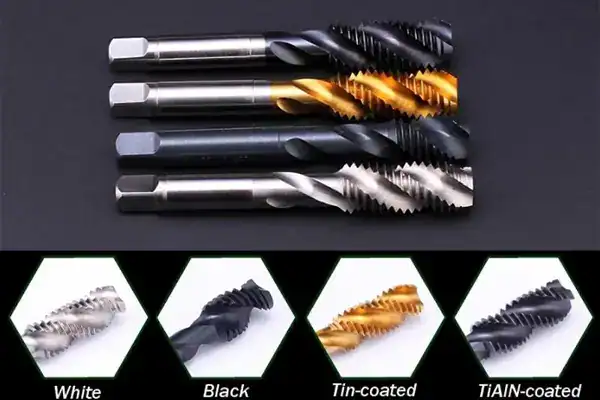
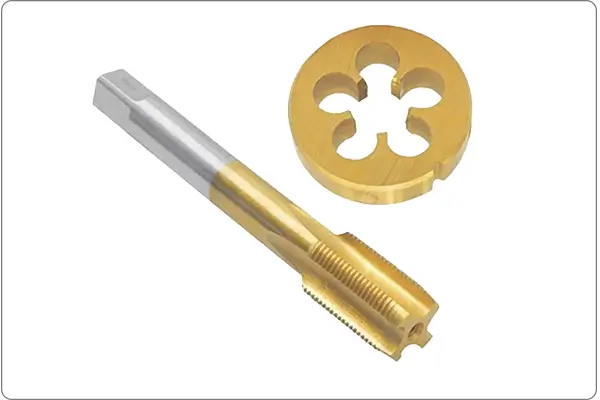
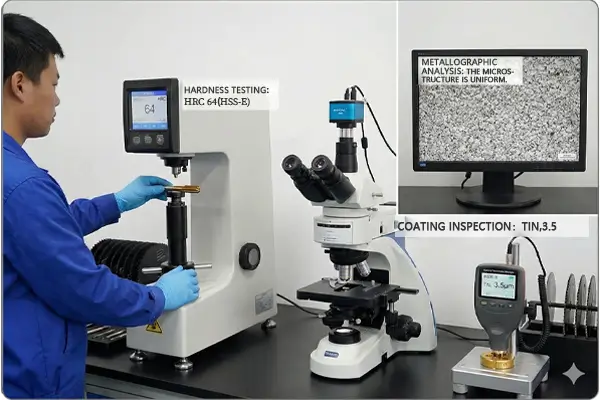
- Tap Coatings[^4]: TiN, TiAlN, TiCN, and oxide improve lubricity, heat resistance and wear. Choose the coating based on the metal being tapped and overall job demands (see table below).
| Malzeme | Sertlik | Kuvvet | Best For | Typical Coating |
|---|---|---|---|---|
| HSS | 62–64 HRC | Tough | Alloy steel, general use | TiN, oxide |
| Cobalt HSS | 67–68 HRC | Tougher | Stainless, hard alloys | TiAlN, TiCN |
| Karbür | >70 HRC | Hard | Cast iron, aluminum, mass | DLC, TiN |
Size, Tolerance and Standards
Thread taps come in metric and imperial sizes; major diameter and pitch are specified for correct fit. Tap tolerances (H1-H4) control the fit and grade of internal thread according to standards (ISO, DIN, ANSI, JIS).
| Tap Tolerance[^5] | For Internal Thread Class | Common Application |
|---|---|---|
| H1 | 4H/5H | Precision, fine thread |
| H2 | 5G/6H | General fit |
| H3 | 6G/7H, 7G/7H | Loose fit, repair |
| H4 | 6H/7H | Hand taps, coarse work |
Correct tap and drill size matching is vital. A hole drilled too small causes high cutting torque and risk of breakage.
Preventing Tap Breakage & Common Issues
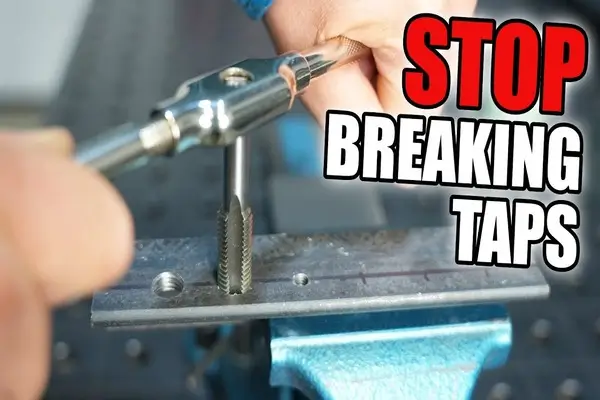
Tap breakage is a persistent problem, often caused by:
- Wrong tap type/material for workpiece and hole
- Excessive wear, worn cutting edges
- Poor chip clearance or blocked flutes
- Incorrect drill diameter or depth
- Inadequate lubrication or coolant
- Misalignment between tap and hole
- Incorrect speed/feed settings
- Operator error
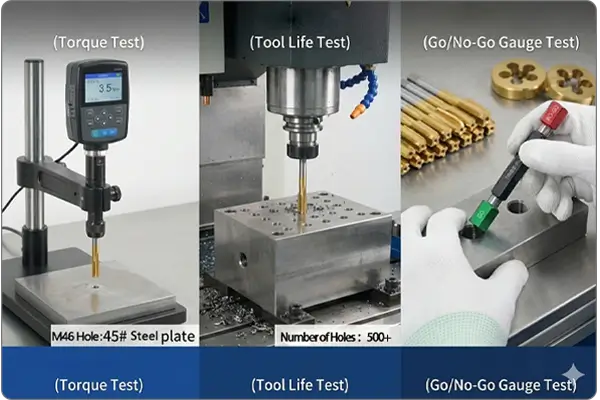
To prevent tap failure, always check hole dimensions, monitor for wear, use correct lubrication, and match tap geometry to the application. For CNC and machine tapping, ensure the spindle and feed are precisely synchronized; use high-quality collets or holders to avoid runout.
Improving Thread Tap Performance
Optimizing process parameters—speed, feed, lubrication, tap geometry—extends life and improves finish. For challenging alloys, advanced coatings and coolant strategies are key. Automated setups and tapping heads with overload, reverse, or torque sensors can further reduce downtime from breakage.
Thread mills offer new possibilities in CNC. They allow tapping of various diameters and pitches with one tool, use less torque, and reduce stress on the spindle—especially important for tough alloys or large threads.
Advanced and Innovative Tapping Techniques
Thread Milling: For high-precision, large-diameter or high-hardness threads, thread milling tools cut by interpolation. This method avoids the risk of tap jamming or breakage and provides flexibility for different pitches and diameters.
Form Tapping[^6]: Cold-forming taps[^7] increase thread shear and tensile strength, producing reliable, burr-free threads and eliminating chip clearance issues for ductile metals.
Smart Taps: Taps with embedded sensors are emerging for automated monitoring, giving real-time feedback on cutting forces, alignment, and wear—boosting process reliability.
Nanocoating and Additive Manufacturing[^8]: Nanocoatings such as diamond-like carbon and custom tap designs via 3D printing are being deployed in aerospace and high-technology parts where standard tap geometries fail.
Future Trends in Thread Tapping
As manufacturing shifts to high-volume, automated production, expect taps to be optimized for specialized coatings, sensor-based monitoring and rapid-change systems. Advances in material science (super-hard alloys, functional surface films) and process integration (real-time force feedback, adaptive cycle control) will make thread tapping faster, safer, and more reliable—especially for exotic alloys and complex, high-performance components.
Request Your Free Sample

## Conclusion
A professional threading operation starts with knowledgeable selection of tap type, material, geometry, tolerance, and machine setup. Matching these to the workpiece material, hole shape, and production demands is essential for [precision internal threads](https://www.tenyutool.com/18-types-of-thread-taps-a-guide-to-choosing-the-right-one/)[^9], tool longevity, and process efficiency. For every job, review the thread profile, workpiece alloy, part geometry, machine capabilities, and tap standards—then select [the optimal tap](https://www.tenyutool.com/19-ways-to-remove-broken-taps-and-drills/ “the optimal tap”) to achieve defect-free results and reliable cycles.
—
[^1]: Learning about thread taps helps in choosing the right tool for creating internal threads efficiently.
[^2]: HSS offers a balance of toughness and wear resistance, making it suitable for general-purpose tapping.
[^3]: Cobalt HSS provides enhanced toughness and heat resistance, ideal for difficult-to-machine metals.
[^4]: Coatings like TiN and TiAlN enhance lubricity and heat resistance, extending tap life and efficiency.
[^5]: Tap tolerance ensures the correct fit and grade of internal threads, crucial for precision applications.
[^6]: Form tapping increases thread shear and tensile strength, producing reliable, burr-free threads.
[^7]: Forming taps produce strong, burr-free threads by displacing material, eliminating chip-related issues.
[^8]: Additive manufacturing allows for custom tap designs, improving performance in specialized applications.
[^9]: Precision in internal threads ensures proper fit and function, critical for high-quality manufacturing.