

Carbide Drill Bit Hardened Steel Manufacturer
- Your Trusted Partner in Premium Hardware Tool Manufacturing
- 15+ Years of Excellence in Hardware Manufacturing
- Wholesale Hardware Sets at Factory-Direct Prices
- OEM & Private Label Services | EN12413 Certified
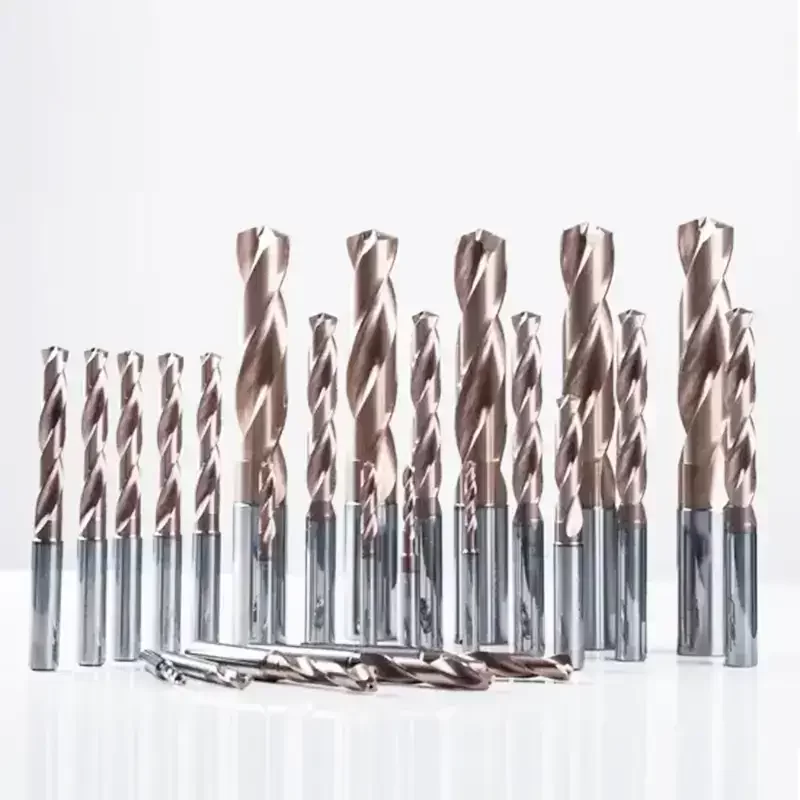
Carbide Drill Bit Hardened Steel Manufacturer From China
- One-stop solution for your purchase
- Your Source for Quality, Competitive Pricing, and On-Time Delivery.
- Fast quotation within 12 hours
- Free samples available for quality check
Your Leading Carbide Drill Bit Hardened Steel Manufacturer & Supplier
SGS & ISO Audited Carbide Drill Bit Hardened Steel
Tenyu Tool, a professional Fast quotation within 12 hours supplier, has been approved by SGS, and obtain ISO quality system certification, ISO environmental management system certification.
Fast Quotation & Professional Export Service
Receive a detailed quotation within 12 hours. Our experienced international sales team understands the requirements of global buyers, providing efficient documentation, packaging options, and customs support.
Global OEM & Distributor Support
We provide private labeling, custom specifications, and technical support services to help distributors, agents, and wholesalers quickly expand their product portfolio with premium, high-margin carbide tooling solutions.
Fast Delivery
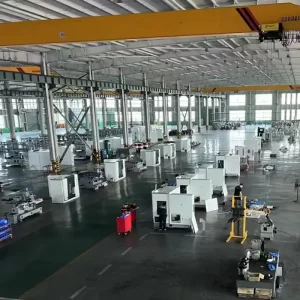
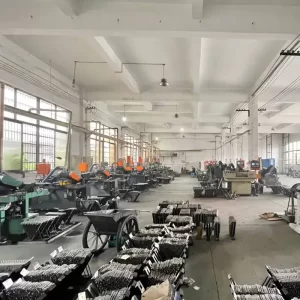
Tenyu Tool keep stable delivery time 7-35 days. Tenyu Tool owns 15 auto production line which will guarantee your delivery date. Even in peak season, we can catch the delivery time. There will be no delay.
Tenyu Tool Professional Production Workshop for Glass Drill Bits
Support online face-to-face factory visits
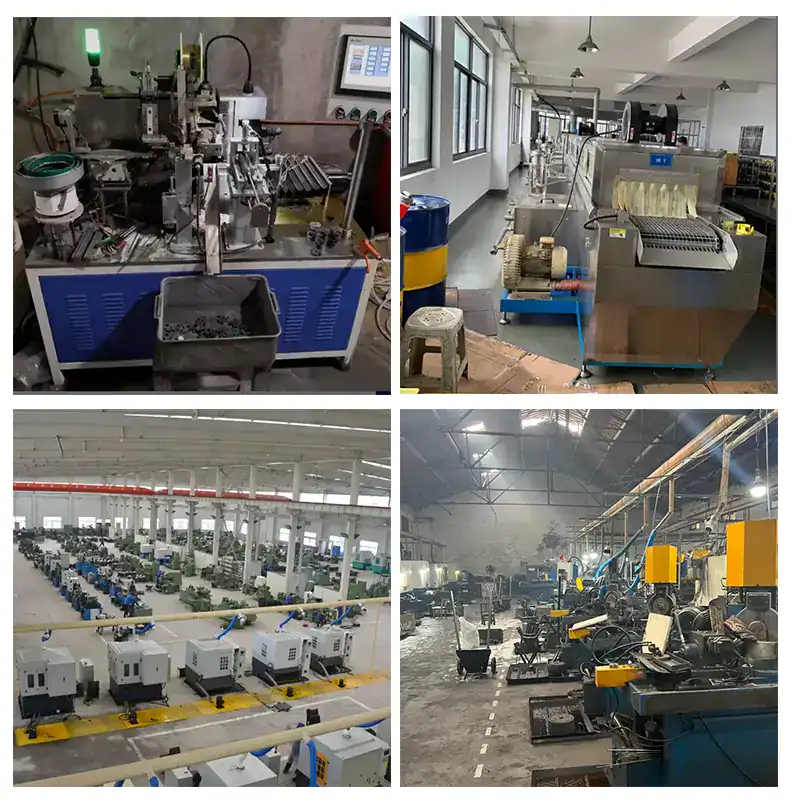
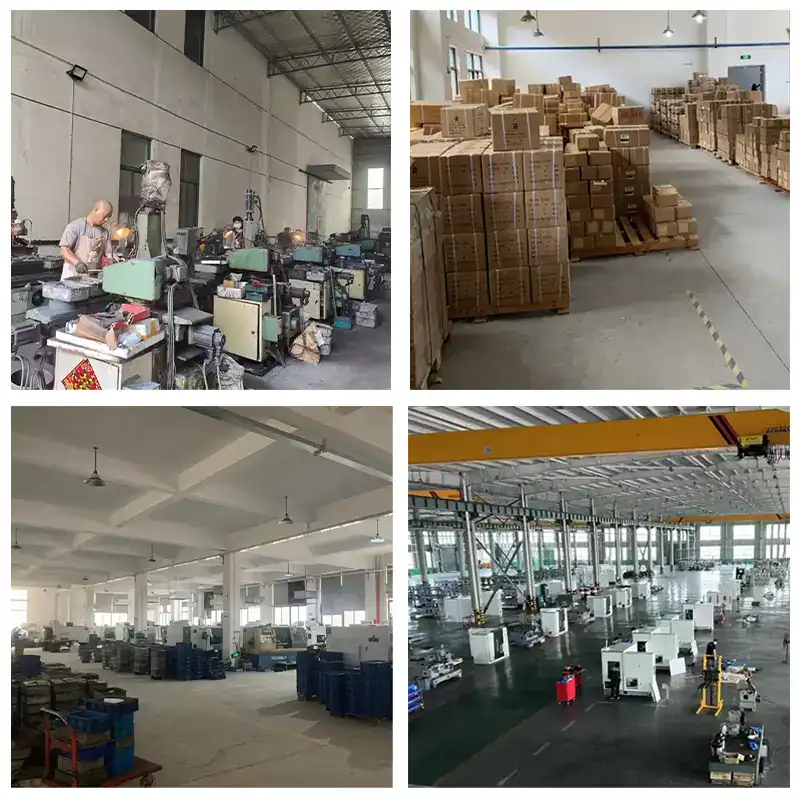
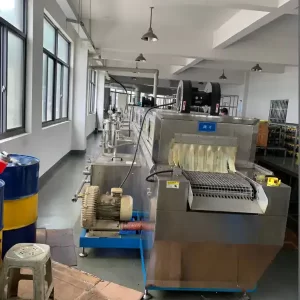
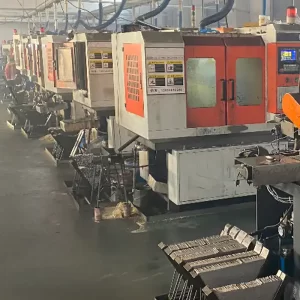
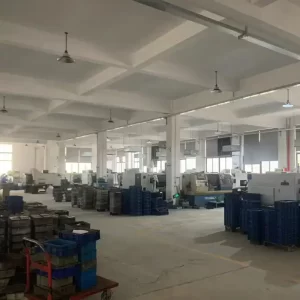
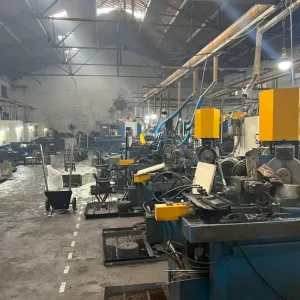
Tenyu Tool Professional Production Workshop for Carbide Drill Bit Hardened Steel
Support online face-to-face factory visits

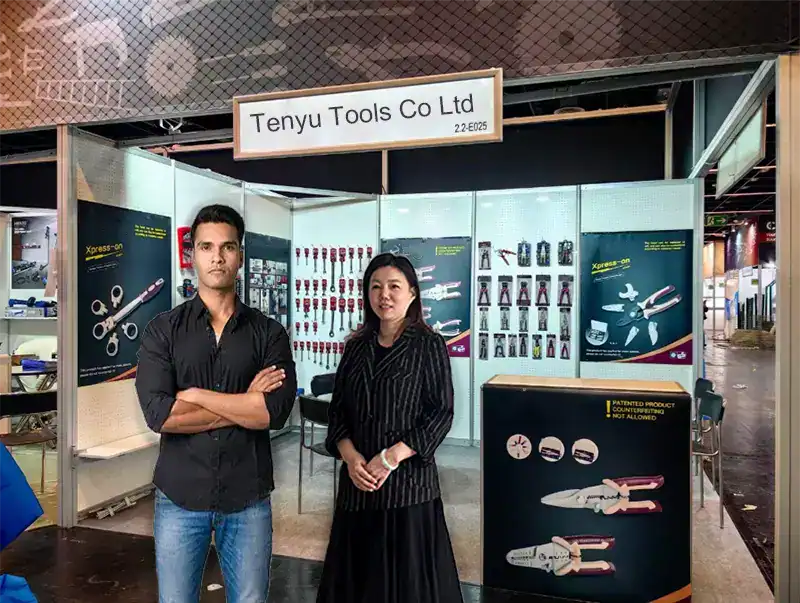
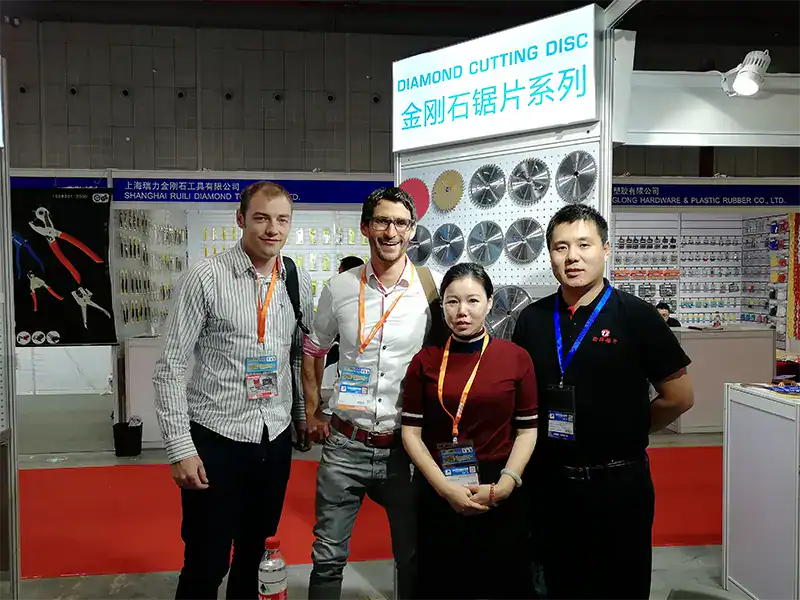
Voice of the World Exhibition
Tenyu Tool actively participates in trade shows around the world and visits our customers, we get closer to them and get more opportunities to present our glass drill bits.


Voice of the World Exhibition
Tenyu Tool actively participates in trade shows around the world and visits our customers, we get closer to them and get more opportunities to present our Carbide Drill Bit Hardened Steel .




Qualification Certificate
Third-Party Verified Excellence: Engineering Confidence Into Every Glass Drill Bits.
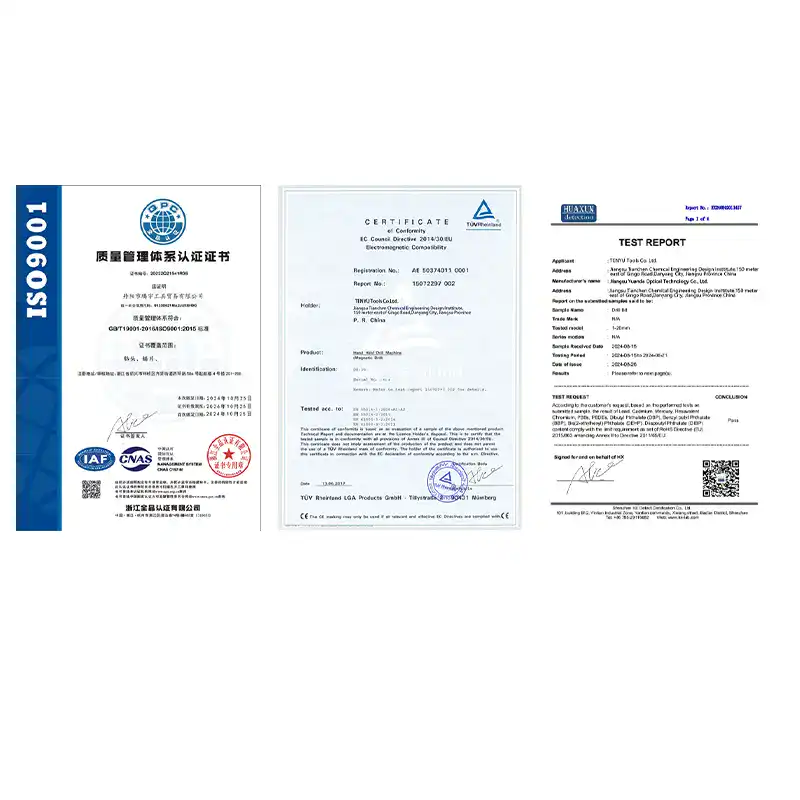
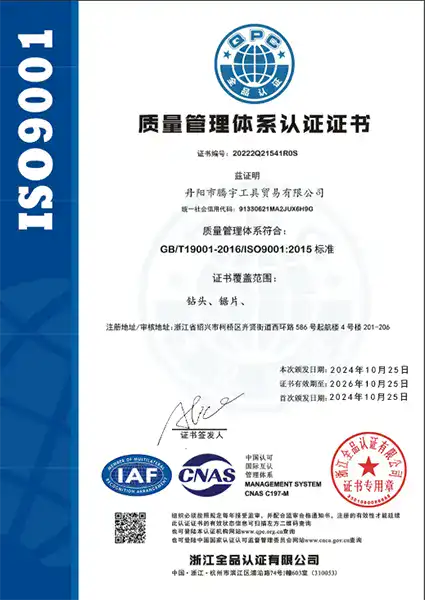
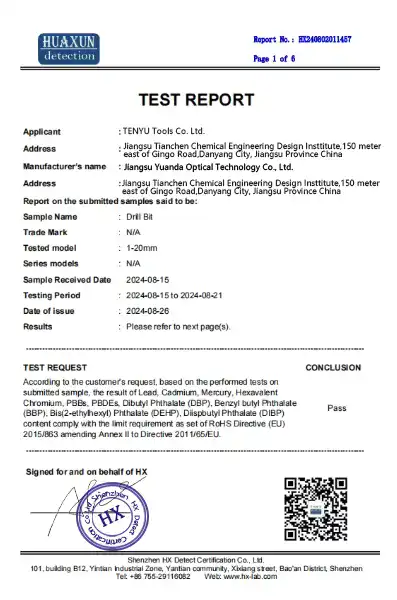
Qualification Certificate
Third-Party Verified Excellence: Engineering Confidence Into Every Carbide Drill Bit Hardened Steel

Carbide Drill Bit Hardened Steel Proper Usage of Drilling Material
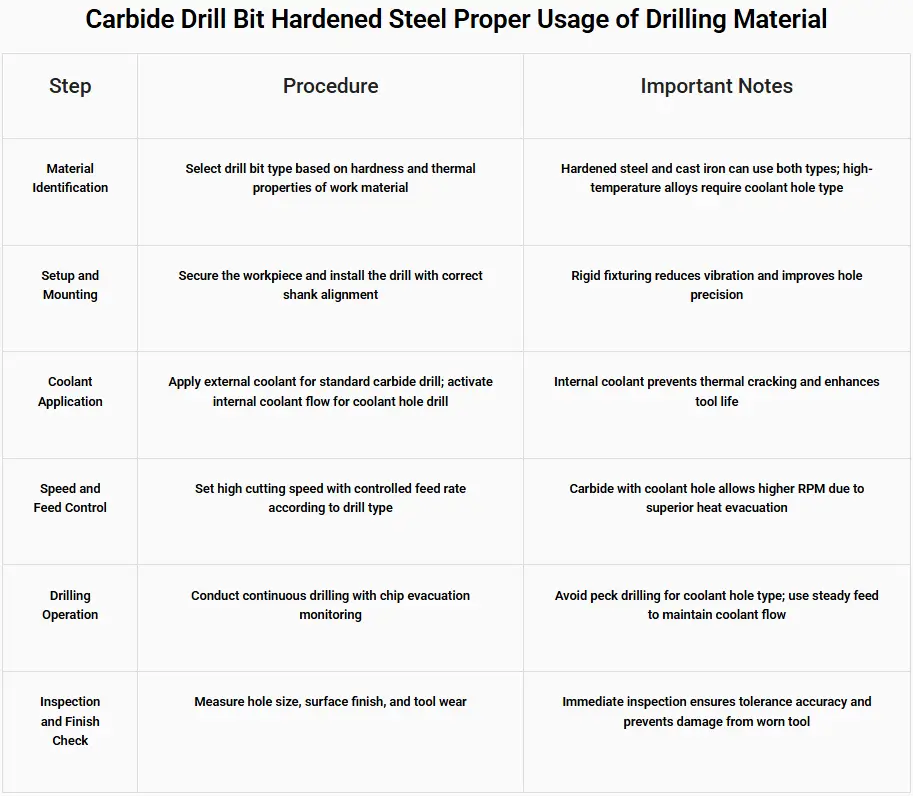
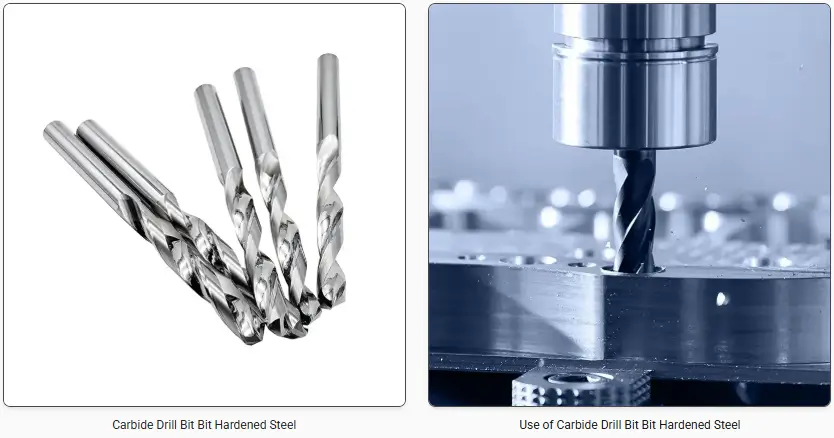
Carbide Drill Bit Hardened Steel Proper Usage of Drilling Material
Step | Procedure | Important Notes |
Material Identification | Select drill bit type based on hardness and thermal properties of work material | Hardened steel and cast iron can use both types; high-temperature alloys require coolant hole type |
Setup and Mounting | Secure the workpiece and install the drill with correct shank alignment | Rigid fixturing reduces vibration and improves hole precision |
Coolant Application | Apply external coolant for standard carbide drill; activate internal coolant flow for coolant hole drill | Internal coolant prevents thermal cracking and enhances tool life |
Speed and Feed Control | Set high cutting speed with controlled feed rate according to drill type | Carbide with coolant hole allows higher RPM due to superior heat evacuation |
Drilling Operation | Conduct continuous drilling with chip evacuation monitoring | Avoid peck drilling for coolant hole type; use steady feed to maintain coolant flow |
Inspection and Finish Check | Measure hole size, surface finish, and tool wear | Immediate inspection ensures tolerance accuracy and prevents damage from worn tool |
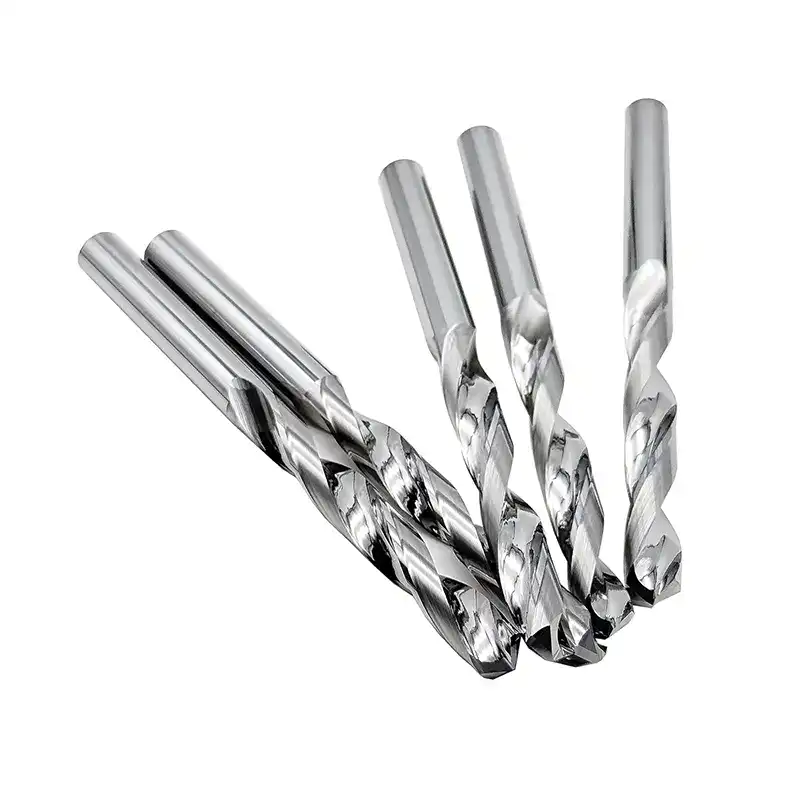
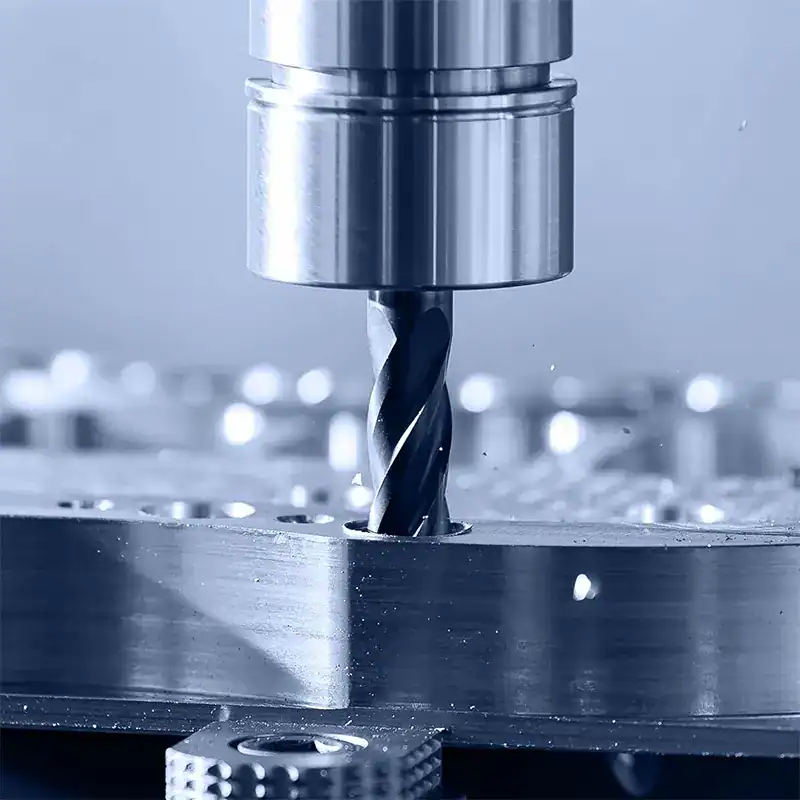
Carbide Drill Bit Hardened Steel Material-Specific Techniques
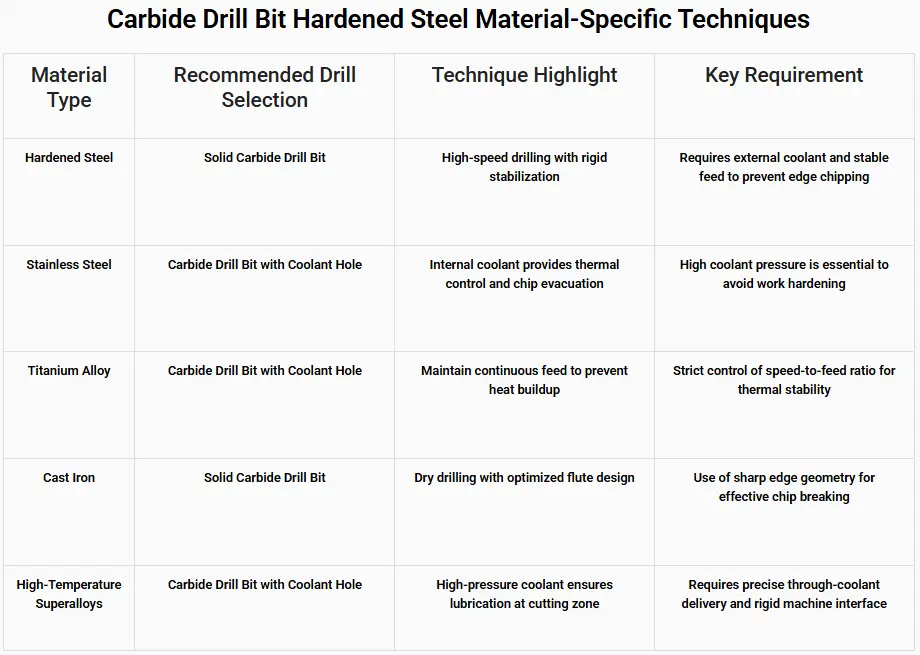
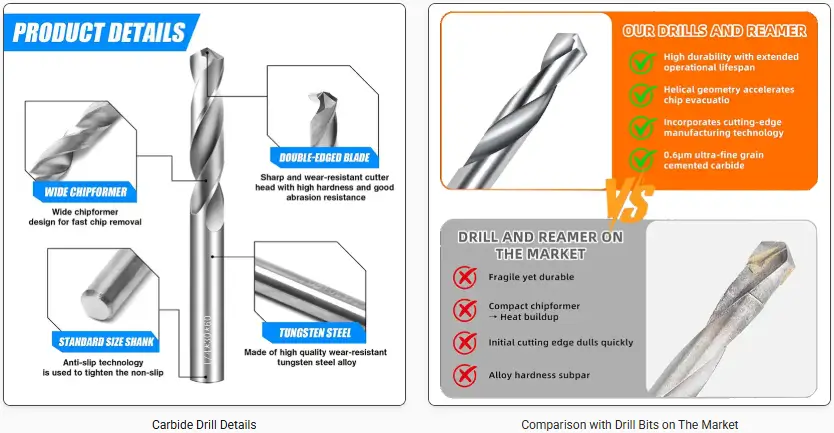
Carbide Drill Bit Hardened Steel Material-Specific Techniques
Material Type | Recommended Drill Selection | Technique Highlight | Key Requirement |
Güçlendirilmiş çelik | Solid Carbide Drill Bit | High-speed drilling with rigid stabilization | Requires external coolant and stable feed to prevent edge chipping |
Paslanmaz çelik | Carbide Drill Bit with Coolant Hole | Internal coolant provides thermal control and chip evacuation | High coolant pressure is essential to avoid work hardening |
Titanium Alloy | Carbide Drill Bit with Coolant Hole | Maintain continuous feed to prevent heat buildup | Strict control of speed-to-feed ratio for thermal stability |
dökme demir | Solid Carbide Drill Bit | Dry drilling with optimized flute design | Use of sharp edge geometry for effective chip breaking |
High-Temperature Superalloys | Carbide Drill Bit with Coolant Hole | High-pressure coolant ensures lubrication at cutting zone | Requires precise through-coolant delivery and rigid machine interface |
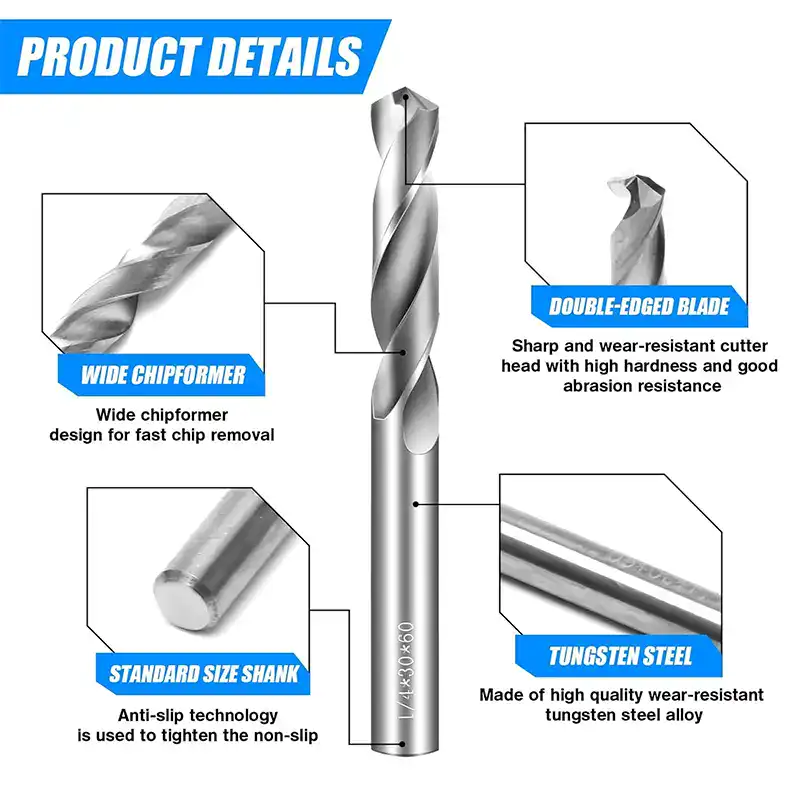
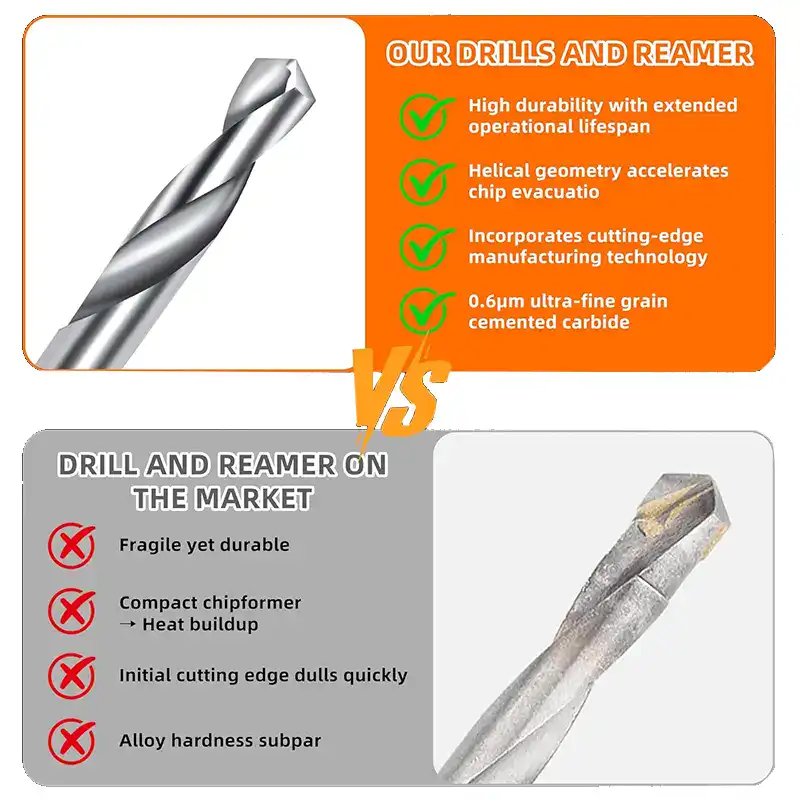
Proper Usage Comparison of Carbide Drill Bit Hardened Steel Types
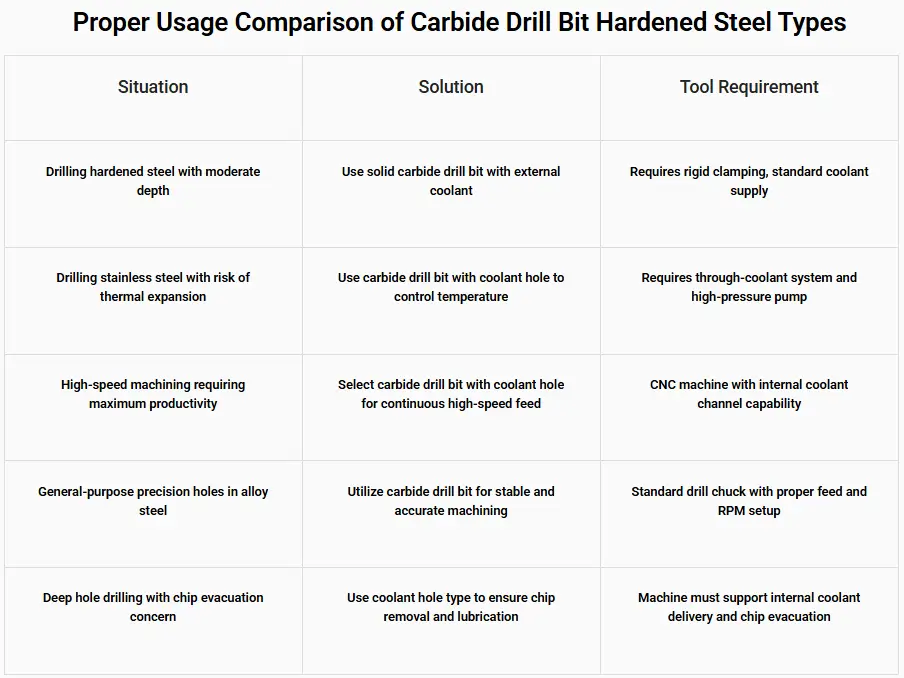
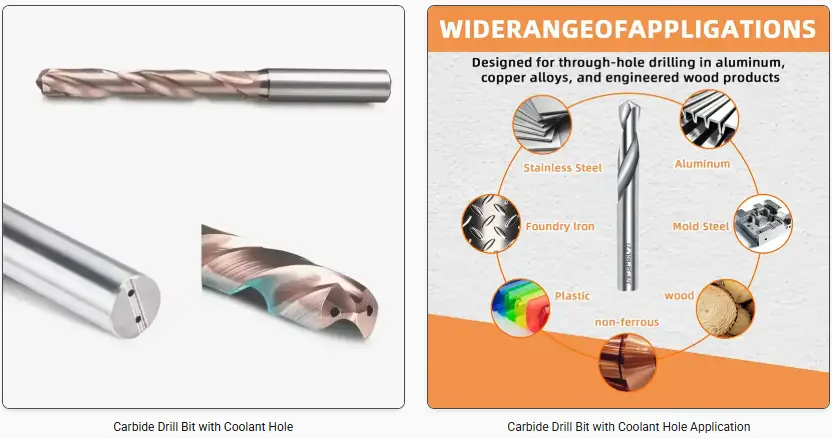
Proper Usage Comparison of Carbide Drill Bit Hardened Steel Types
Situation | Çözüm | Tool Requirement |
Drilling hardened steel with moderate depth | Use solid carbide drill bit with external coolant | Requires rigid clamping, standard coolant supply |
Drilling stainless steel with risk of thermal expansion | Use carbide drill bit with coolant hole to control temperature | Requires through-coolant system and high-pressure pump |
High-speed machining requiring maximum productivity | Select carbide drill bit with coolant hole for continuous high-speed feed | CNC machine with internal coolant channel capability |
General-purpose precision holes in alloy steel | Utilize carbide drill bit for stable and accurate machining | Standard drill chuck with proper feed and RPM setup |
Deep hole drilling with chip evacuation concern | Use coolant hole type to ensure chip removal and lubrication | Machine must support internal coolant delivery and chip evacuation |
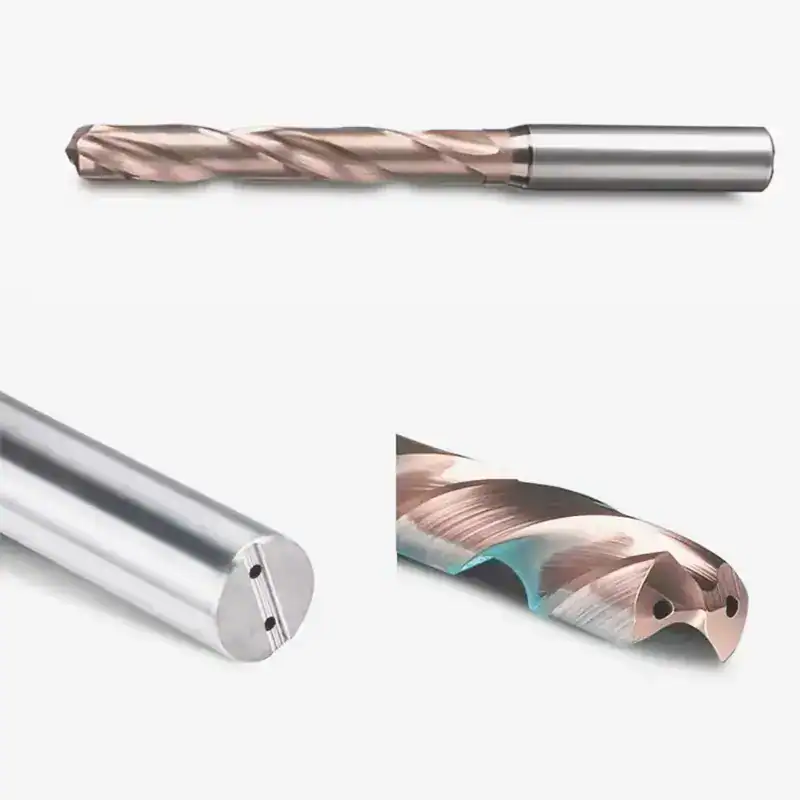
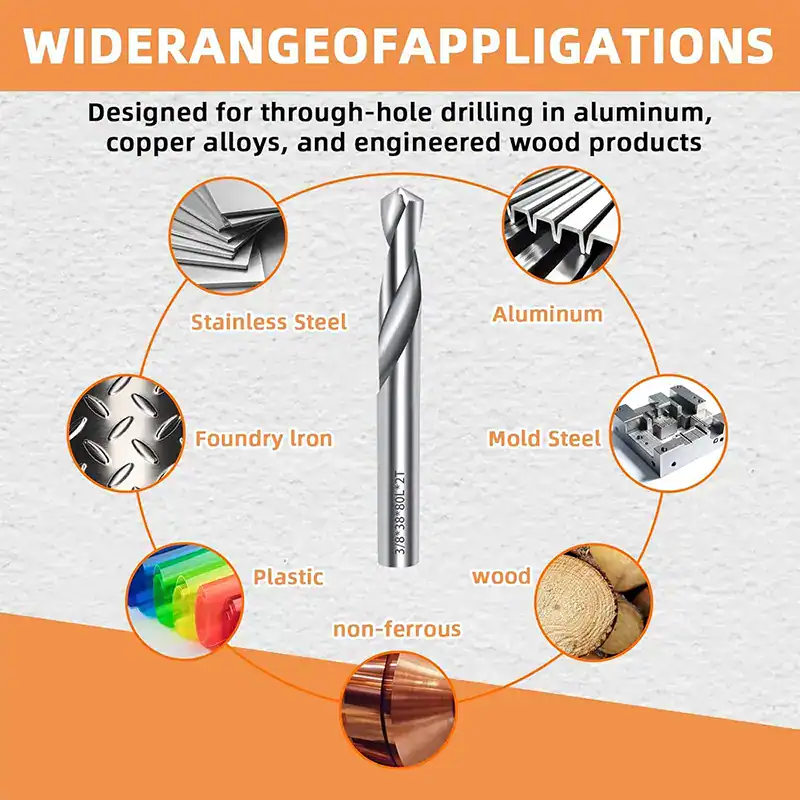
Proper Usage Comparison of Carbide Drill Bit Hardened Steel Types
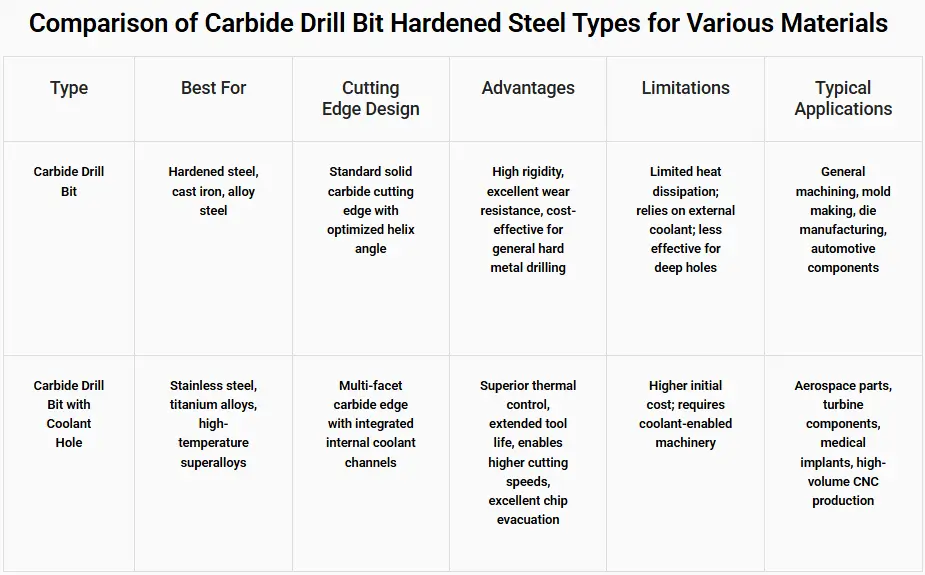
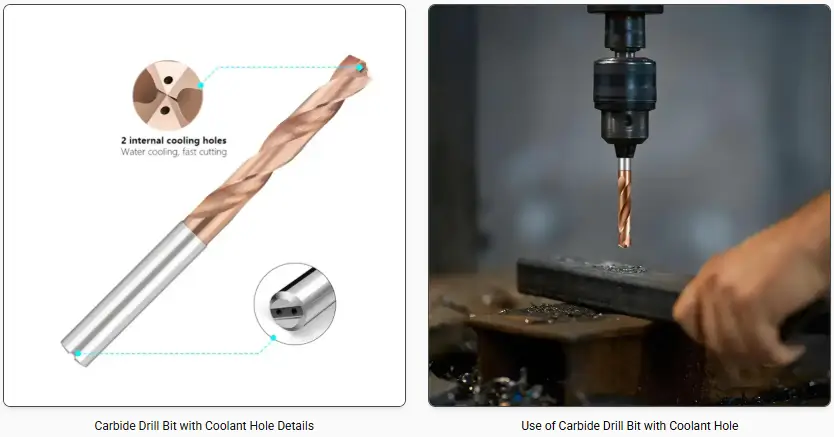
Comparison of Carbide Drill Bit Hardened Steel Types for Various Materials
Tip | Best For | Cutting Edge Design | Avantajlar | Limitations | Typical Applications |
Carbide Drill Bit | Hardened steel, cast iron, alloy steel | Standard solid carbide cutting edge with optimized helix angle | High rigidity, excellent wear resistance, cost-effective for general hard metal drilling | Limited heat dissipation; relies on external coolant; less effective for deep holes | General machining, mold making, die manufacturing, automotive components |
Carbide Drill Bit with Coolant Hole | Stainless steel, titanium alloys, high-temperature superalloys | Multi-facet carbide edge with integrated internal coolant channels | Superior thermal control, extended tool life, enables higher cutting speeds, excellent chip evacuation | Higher initial cost; requires coolant-enabled machinery | Aerospace parts, turbine components, medical implants, high-volume CNC production |
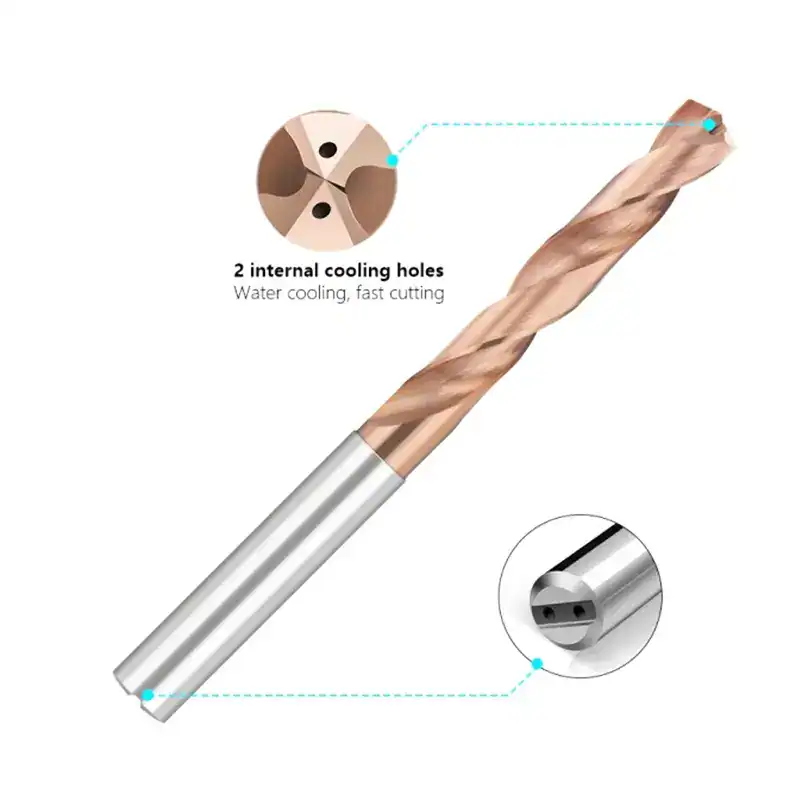
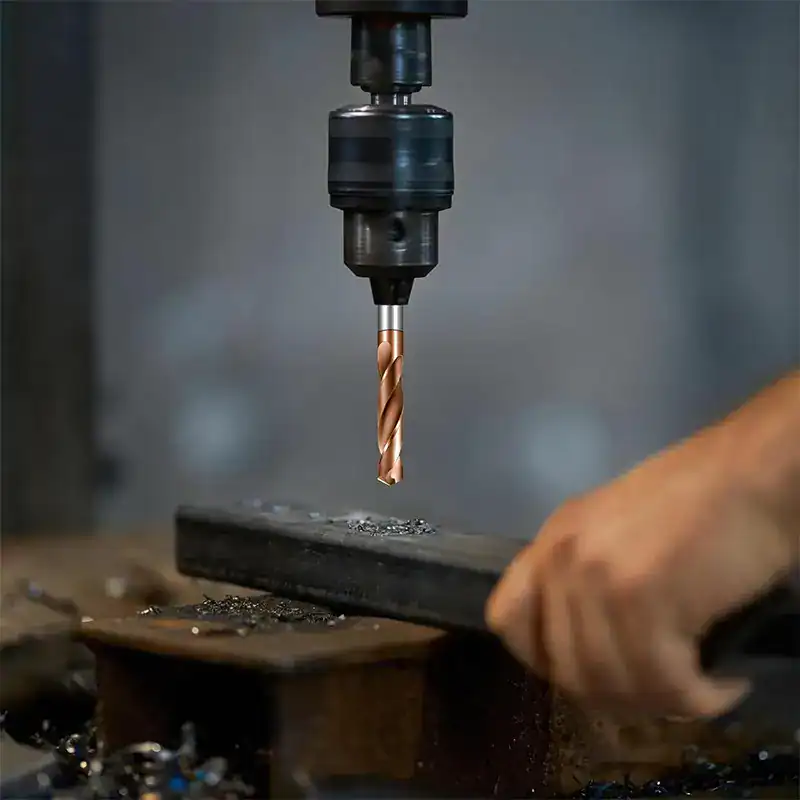
Table of Contents
Top Carbide Drill Bit Maker for Hard Metal Applications
In the complex world of metal work and machining, choosing the right drill bit is sometimes even more important than being a talented machinist or wielder. In fact, when you’re going up against dense materials like hardened steel or cast irons, getting it wrong here can cost you an entire afternoon to just drill one hole.
Understanding Carbide Drill Bits
Carbide twist drill bits represent a smaller leap forward in drilling technology, but are nonetheless miles better than their traditional steel bit counterparts in a number of important ways—particularly when it comes to bearing the standard wear and tear of working with materials like hardened steel. The special features of and characteristics inherent in the carbide material (most often tungsten carbide) provide these drill bits with the ability to keep their sharpness, a finely obtained cutting edge, even when they are used at high temperatures for long periods.
Their superior wear and abrasion resistance also greatly extends the tool’s life, on average 50-60% when compared to other leading karbür matkap uçları, resulting in less down time due to frequent changing of dull/damaged drills and increased drilling efficiency.
What are Carbide Drill Bits?
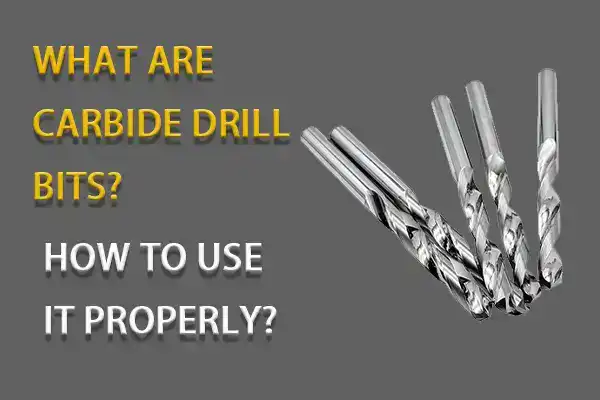
A solid carbide bit will give you maximum rigidity and precision, but cobalt is a more economical option for applications that don’t require the benefits of solid carbide. The fabrication technology installs tiny carbide grains into the matrix (typically cobalt), adding impact resistance and preventing the bit from cracking under pressure.
Types of Carbide Drill Bits
There are a variety of carbide drill bits on the market designed for different drilling purposes. Here’s a breakdown of the most common types:
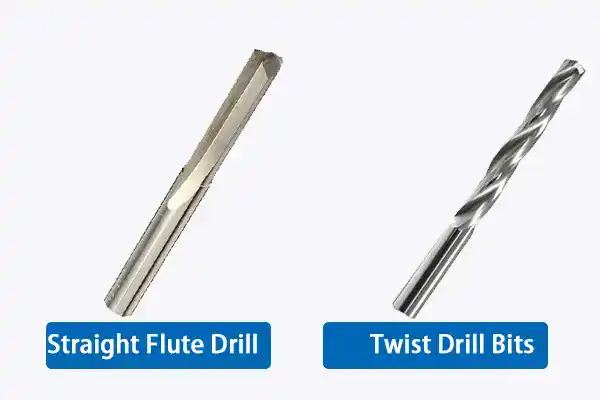
Drill Bit Type | Başvuru |
Carbide twist drill bits | Versatile choice for general-purpose applications. |
Straight flute drill (including carbide straight flute ) | Best suited for ferrous material that tends to stringy chips. |
About specialised designs, if you know you will be working with certain materials, there are designs to help you achieve even better results – and they won’t break the bank either. A solid carbide 3-fluted drill bit is designed specifically to perform much better in certain materials.
Advantages of Carbide Drill Bits
Using carbide drill bits offers several, important benefits as well when you are working with tough materials such as hardened steel. Here’s a breakdown of some of the main advantages:
Benefit | Impact |
Superior Hardness of Carbide | Long tool life, reduced commander or need to change tools, better hole tolerances and less total cost of the finished piece. |
Enhanced Heat Resistance | Capable of keeping a sharp cutting edge at high temperature, reducing the hardness and thermal softening of drill bit when drilling with high speed. |
Exceptional Wear Resistance | Reliable long service life, less line downtime, more holes in fewer rods and bit changes even when working with an abrasive material. |
Increased Drilling Speed | Quicker material removal rates mean superior productivity and less cycle time overall, which results in enhanced efficiency and profitability. |
Improved Hole Quality | Accurate Hole size, better surface finish with less burr on finished parts. |
Whether you use a full set of carbide drill bits, or specific drill bit types (the best picks for hardened steel), making this choice to pick up hard-wearing carbide cutting tools will pay dividends many times over – in time saved, quality improved, and costs reduced.
Applications in Hardened Steel
When Should You Use Carbide Drill Bits for Hardened Steel?
When your job calls for drilling through hardened steel, one of the most important tools you will use is a drill bit. Carbide drill bits’ exceptional characteristics are well-suited for industrial use, especially when compared to high-speed steel drill bits.
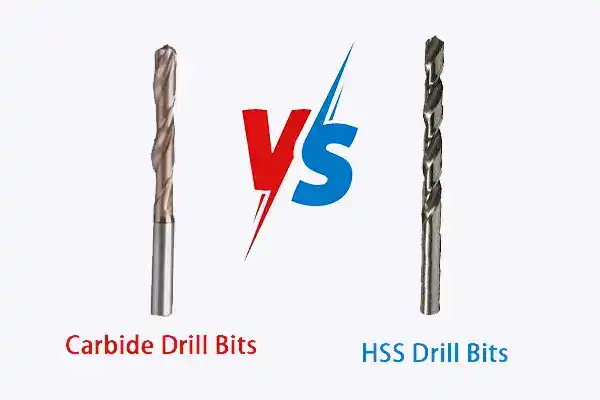
Drill Bit Type | Key Characteristics |
Karbür Matkap Uçları | Uncompromising hardness, excellent resistance to wear, keeping the cutting edge at high temperatures and excellent balance of durability. |
High Speed Steel Drill Bits | Lower hardness, lower heat resistance and shorter life when compared to carbide drill bits, which makes them more brittle and less durable than carbide based drill bits. |
Use of carbide drill bits results in drilling at higher speeds, extended tool life and increased accuracy when handling stainless steel or high temperature alloy workpieces for greater productivity at lower cost. This use of a carbide tipped drill bit provides the practical compromise between cost and performance in certain less-demanding applications.
Solid carbide drill bits performance
Solid carbide drill bit is considered the best in the business when it comes to drilling through hardened steel, and its feature set offers great speed, durability at no expense to precision that will not disappoint you. Their solid construction, which is generally made of tungsten carbide, provides maximum stability that effectively eliminates vibration and deflection when drilling. This inherent rigidity produces a cleaner, more accurate hole with no deflection, reduced potential for drill bit breakage and better overall drilling efficiency.
Solid carbide drill configurations are very effective in high production applications where precision, tight tolerances and consistent repeatability become critical. In particular, in situations where chip evacuation is critical, a solid carbide 3-flute drill may be preferred to increase productivity and provide faster penetration rates.
Comparison with Other Materials
Despite the fact that high-speed steel and cobalt drill bits work great in some metalworking applications, they underperform when drilling through hard metals. Because of the material they are made from, carbide drill bits can penetrate much harder materials, which in turn makes them great for drilling through steel. For applications in stainless steel, alloy steel and similar hard-to-machine work materials, there is also a significant performance advantage – plus sustainability and cost savings.
Features of Carbide Drill Bits
Flute Design and its Importance
Carbide drill bit flute design The flute configuration of a carbide drill bit plays a crucial role in its overall performance, especially when cutting hardened steel. Flute is the primary conveyer of chips as the bit is drilled into the material, preventing clogging and over heating. Various flute forms like straight flute drill or carbide straight flutes are very precisely matched to certain materials and applications. Good chip removal is very important in order to keep the cutting layer working constantly and avoid damages to the workpiece, as well as to achieve drilling efficiency.
Understanding the Shank Types
The shank of a carbide drill bit is the most important interface between the drill bit and of the drilling machine or chuck. There are various shank types such as straight, reduced and pre-threaded that help the bit to fit different drilling systems and holes which are used to make a secure connection. Choosing the right shank style is the key for efficient drilling results, accurate to size bored holes, minimized vibration and secure clamping, especially on hardened steel.
Jobber vs. Twist Drill Bits
When reviewing carbide drill bits, you have to tell apart jobber drill bits and regular büküm matkap uçları. The term jobber length is a general categorization of the overall length for standard drill bits. Carbide twist drill choices include jobber, extended length drills- to cope with drilling deep and awkward discussions. Jobber length – general purpose drill for a wide range of applications when a bit is more than adequate to do the job.
The Ideal Carbide Drill for the Job
Factors to Consider
How to choose the right carbide drill bit for drilling hardened steel involves careful consideration of several factors: not only the material but also the equipment being used in hole-making. The tensile strength and composition of the hardened steel, size and depth of hole to be drilled, required precision/surface finish are some important variables which play an important role. For some this might be a carbide-tipped drill, in others the greater efficiency of a solid carbide drill could become necessary.
Common Mistakes to Avoid
In those cases that you are using carbide drill bits for hardened steel, then it is equally important to avoid making mistakes in the choice of tools so as to lengthen the life of such tools, get better performance and prevent accidents. Too much grinding force can result in the grinder overheating and reduced lifetime.
The cutting ability will be very inefficient or broken if you cut at the incorrect speed and feed rate. If you do not properly secure the workpiece, this can cause vibration and inaccuracy during drilling. Keep in mind that patience, precision and adherence to correct operating parameters are needed each time you use a carbide drill tool.
Maintenance and Care for Longevity
Cleaning and Storage Tips
With the strategy of acceptance, maintenance and warm care, the prolonged life can be achieved. Carbide drill bits drilling hardened steel: The proper maintenance and careful use of karbür matkap uçları are necessary for their long service life and cutting performance, as used for drilling hardened steel. After use, carefully clean drill bit to remove built up dirt, chips or swarf. Keep the carbide drill bits in the dry and safe place, either a storage case or toolbox. Avoid the bit to be affected by water or damp or any acid so that it could last longer. Rain, corrosive material can accelerate the reactivity of the carbide and may cause rust.
Sharpening Solid Carbide Drill Bits
But, sharpening solid carbide drill bits is a bit of an art form and much more difficult than sharpening high-speed drill bits. The extraordinary hardness of tungsten carbide juxtapositioned with the traditional techniques used to sharpen steel drill bits, render a poor response and may ruin your drill bit. Carbide drill bits are critical to ensure longevity and accuracy in drilling through hard metals like steels it is important to keep the cutting edge as sharp as possible.
How Do You Know When to Change Your Drill Bits
It is very important to determine when a karbür matkap ucu should be replaced in order to maintain drilling performance and avoid potential damage to the workpiece as well as the safety of operators. When a drill bit shows clear signs of excessive wear—chipped cutting edges, a much diminished performance rate, or an obvious vibration in the tool—it’s time for a new bit.